Laurie's Blogs.

Dec 2025
Advancements in Post-Operative Management of Medial Patellar Luxation in Small-Breed Dogs: Insights from Recent Studies
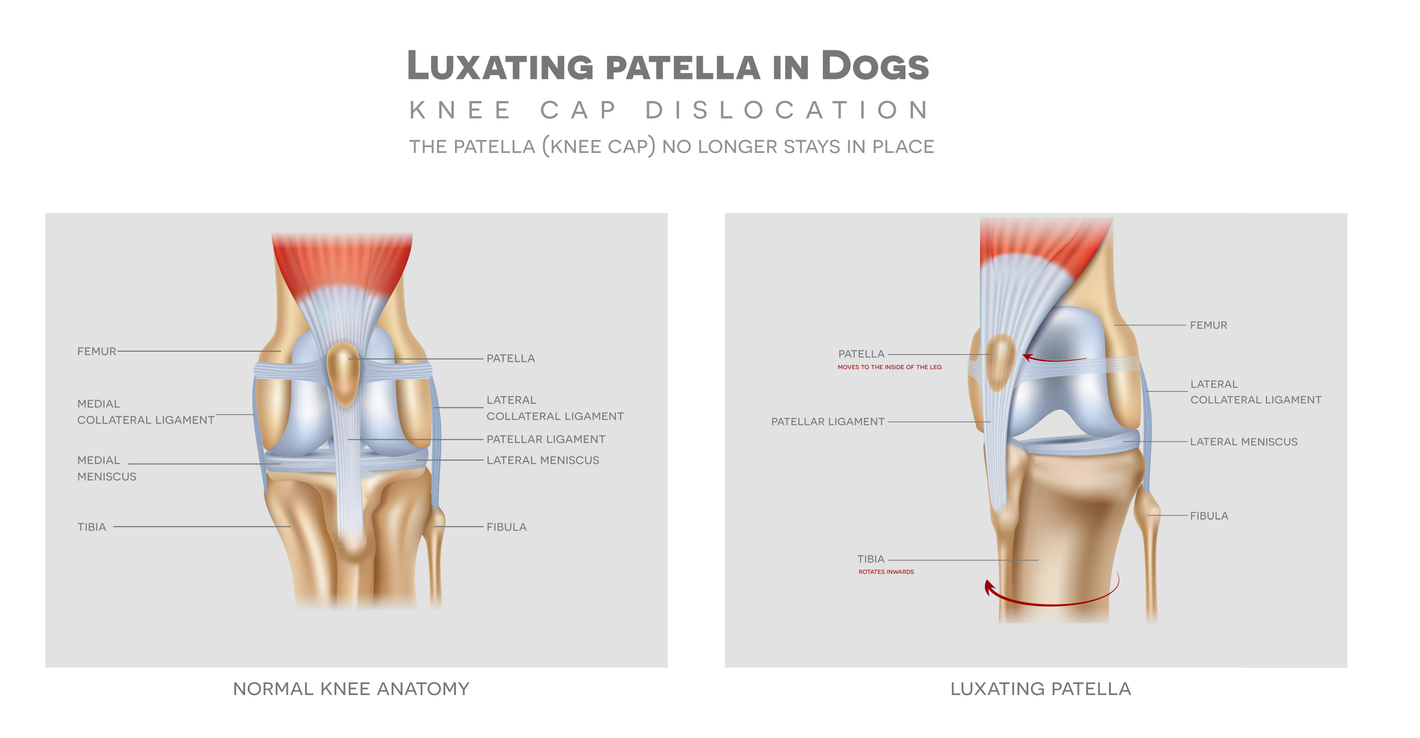
Medial patellar luxation (MPL) remains a prevalent orthopedic issue in small-breed dogs, often necessitating surgical intervention. Two recent veterinary studies provide valuable data on post-operative rehabilitation and biomechanical recovery, offering evidence-based guidance for clinicians. Here, we highlight key findings and discussions from these papers, focusing on their implications for small-animal practice.
1. Comparative Efficacy of Rehabilitation Modalities Post-MPL Surgery
In a prospective clinical trial published in Veterinary World (2024), Akaraphutiporn et al. evaluated post-operative rehabilitation strategies in 26 small-breed dogs (31 stifles) following MPL surgery. Dogs were divided into three groups: a control group with owner-implemented home exercises (e.g., passive range of motion [PROM], standing exercises, and leash walking); a group using interferential current (IFC) alongside aquatic treadmill therapy; and a LASER group recieving at 4–8 J/cm², also combined with underwater treadmill sessions.
Key Findings: No significant differences were observed among groups in lameness scores, pain scores, thigh muscle circumference, or stifle ROM over 12 weeks. All groups demonstrated improvements in limb function and pain relief, suggesting that some form of structured rehab enhances recovery regardless of modality.
MY THOUGHTS: In a post operative case, modalities to target pain management should have a short window of applicability. That time in which pain is a factor and impediment to function. This study continued to use the same protocol for 84 days (12-weeks). That’s not the hallmark of a professionally designed rehab program. A rehab program should progress along with the functional capabilities of the patient. So, I’m not surprised that ate the 12-week mark, there was no difference between the groups. If anyone wants to create a future study, it would be interesting to look at a continually progressing / intensive rehab program compared to a home management program as the one that was described in this study.
2. Biomechanical Recovery in Chihuahuas with Grade III MPL
A complementary study by Chayatup et al., published in The Veterinary Journal (2025), used two-dimensional kinematic and goniometric analyses to assess active (AROM) and passive (PROM) ROM in the stifle, hip, and tarsal joints of 17 Chihuahuas—10 with Grade III MPL and 7 healthy controls. MPL dogs underwent surgical correction (e.g., trochlear block recession, tibial tuberosity transposition), with evaluations pre-operatively and at 2, 4, 6, and 8 weeks post-op.
Key Findings: Pre-operatively, MPL dogs exhibited significant reductions in stifle AROM and PROM, particularly extension, with compensatory increases in hip and tarsal AROM, indicating adaptive biomechanics. Post-surgery, stifle AROM progressively improved, nearing control values by week 8, while PROM remained persistently limited. Hip and tarsal AROM showed early compensatory changes that resolved as stifle function recovered.
Discussion Points: The persistent PROM deficits underscore stifle instability's lasting impact, advocating for early, targeted rehabilitation to address joint flexibility and prevent long-term dysfunction. The study highlights compensatory mechanisms in adjacent joints, suggesting a multimodal rehab approach (e.g., PROM exercises, aquatic therapy) to optimize outcomes. These benchmarks for joint motion could refine surgical evaluations and personalize post-op care, especially in breeds like Chihuahuas prone to MPL.
MY THOUGHTS: I like this study because it directs us to something tangible that rehab should focus on in post-operative MPL cases. In addition to the rehab approaches suggested above, I would add joint mobilizations to increase end ranges of motion. Joint supplements could well be in order, and modalities such as laser therapy could be directed at the tibiofemoral joint to enhance the effectiveness of the manual techniques for increasing ROM.
Clinical Implications and Future Directions
These two papers were the only ones that popped up when I did a pubmed search on post-operative rehabilitation for medial patellar luxation in dogs. There are still so many things to research in our field. These two papers get us started down that path!
References:
Chayatup K, Wangdee C, Soontornvipart K. Preoperative and postoperative joint motion in chihuahuas with Grade III medial patellar luxation: A kinematic and goniometric analysis. Vet J. 2025 Oct;313:106369.
Akaraphutiporn E, Kwananocha I, Meechai C, Suksomboonwong P, Aramsriprasert S, Meethong O, Triampitak A, Wangdee C. Comparative analysis of post-operative rehabilitation approaches for medial patellar luxation in small-breed dogs. Vet World. 2024 Mar;17(3):550-557.