Laurie's Blogs.

May 2026
New Study: Thoracic Spondylosis Deformans in Search-and-Rescue Dogs — Key Findings from a 15-Year Surveillance Program
If you work with working dogs, sporting dogs, or any high-drive canine athletes, a brand-new study from the American Journal of Veterinary Research (published online March 2026) should be on your radar. “Thoracic Spondylosis Deformans in Search-and-Rescue Dogs,” delivers the first detailed look at this common spinal ‘enthesopathy’ in a large, well-documented cohort of SAR dogs — and the numbers are eye-opening.
Study Overview
The researchers analyzed 558 thoracic radiographs from 127 SAR dogs enrolled in a long-term medical surveillance program that began in 2002. These dogs included handlers’ dogs that responded to the September 11, 2001, terrorist attacks as well as other active SAR dogs. All dogs in the cohort performed comparable high-intensity working tasks involving sustained locomotion over varied and unstable terrain.
Key results:
• Prevalence: Thoracic SD was identified in 81 of 127 dogs (63.8%).
• Age at first radiographic detection: Mean 8.7 years (range 2.0–15.8 years).
• Severity (among the 81 affected dogs):
o Mild: 52.9%
o Moderate: 32.8%
o Severe: 14.2%
• Progression: Radiographic progression occurred in 40% (32/81) of affected dogs.
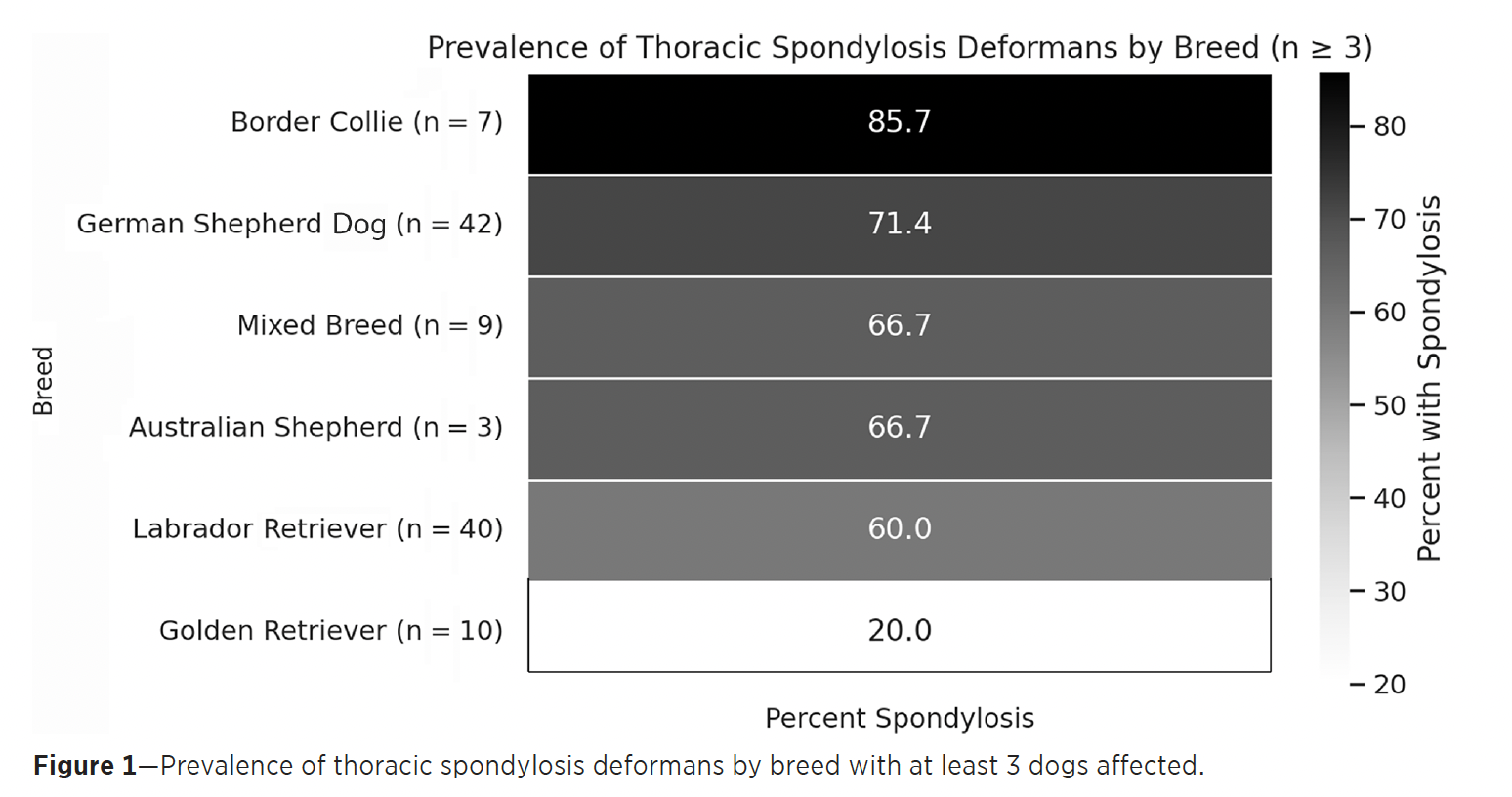
• Breed distribution: The condition was observed across multiple breeds. The two most represented breeds were German Shepherd Dogs (n=42; 71.4% affected) and Labrador Retrievers (n=40; 60.0% affected). Prevalence varied by breed group (e.g., 85.7% in Border Collies with n=7; 20.0% in Golden Retrievers with n=10), though small sample sizes in some breeds warrant caution in interpretation.
The paper notes that these thoracic prevalence figures appear higher than those reported in earlier studies of general pet populations (approximately 28% in German Shepherd Dogs and 23% in Labrador Retrievers).
Figure 1
What the Paper Emphasizes
Spondylosis deformans is described as an enthesopathy involving osseous proliferation at vertebral endplates, related to repetitive biomechanical stress, microtrauma, and age-related changes rather than a primary osteophyte or disc disease process. In the thoracic spine, ventral bridging typically does not cause nerve root compression, though the authors highlight the potential functional impact in dogs performing physically demanding tasks.
Clinical Relevance
“Although historically considered an incidental finding, the identification of thoracic SD may inform long-term musculoskeletal monitoring and clinical management strategies for SAR and other working dogs.”
The authors conclude that thoracic SD is “a common and sometimes progressive finding in SAR dogs” and state that these descriptive data should encourage monitoring for occurrence and progression throughout a working dog’s career. They also note the value of documenting spinal changes in populations exposed to sustained physical demands and call for future prospective studies incorporating physical examinations, advanced imaging, and performance metrics to clarify clinical significance.
What This Means for Canine Rehabilitation Professionals
• Screening. Annual thoracic (and ideally full spinal) radiographs in dogs >5–6 years old might catch early signs and changes. Manual palpation (i.e. dorsoventral pressures might also be useful to detect spinal mobility changes.
• Progression is common. Build longitudinal monitoring into your programs: track subtle signs like reduced hindlimb drive, shortened stride, reluctance on uneven surfaces, or compensatory patterns.
• Rehab focus areas:
• Core and paraspinal strengthening
• Thoracolumbar mobility and myofascial work —manual therapy directly to the thoracic spine and ribs, as well as adjacent segments might help to delay progression and improve comfort.
• Proprioceptive and neuromuscular retraining — crucial for any dog that work on unstable terrain.
• Load management — educate handlers on periodization, recovery days, and recognizing when “just push through it” becomes counterproductive (when not on active duty).
• Broader working-dog population. Although the study focused on SAR dogs, the repetitive spinal loading described applies to police K9s, military working dogs, herding/sport dogs, and even active pet athletes doing agility or dock diving.
Bottom Line
As canine rehab practitioners, we are uniquely positioned to translate these radiographic findings into functional improvements. Routine monitoring + targeted, proactive rehabilitation can make a real difference in the working lives of these incredible dogs.
Read the full open-access paper here:
Powers GJ, et al. Thoracic spondylosis deformans in search-and-rescue dogs. Am J Vet Res. 2026. doi:10.2460/ajvr.25.08.0309