Laurie's Blogs.

Jul 2026
Comparing Canine Abdominal Muscle Function to the Human Core
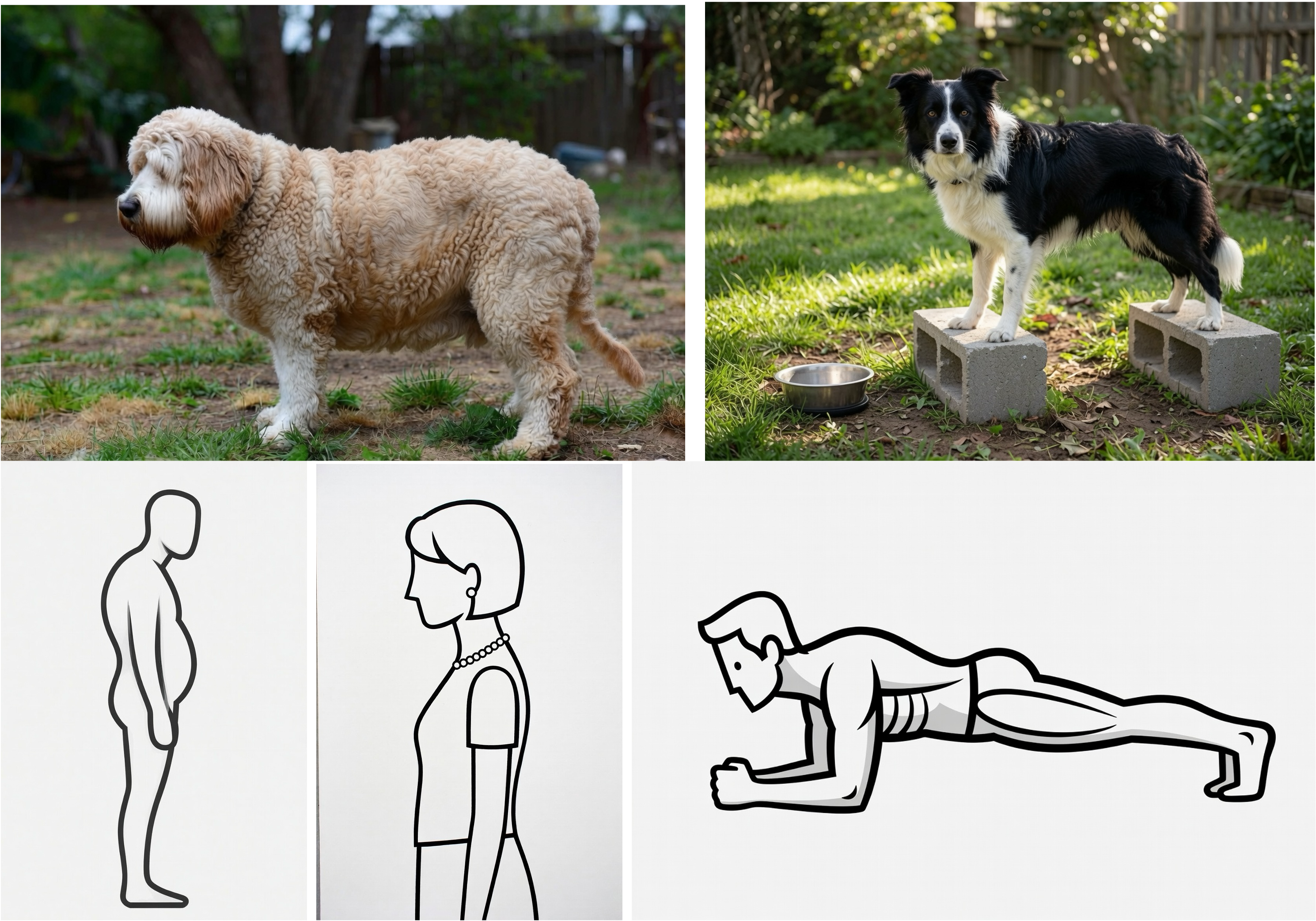
The canine abdominal muscles (rectus abdominis, external oblique, internal oblique, and transversus abdominis) form a key part of the "core" in dogs, much like the human core complex. However, evolutionary adaptations to quadrupedal vs. bipedal locomotion, spinal orientation, and gravitational demands create notable differences in function, emphasis, and clinical relevance. Both systems prioritize stability, force transmission, respiration, and visceral support, but the demands differ significantly.
1. Anatomical Similarities
Both species share the same four primary abdominal wall muscles with comparable fiber orientations:
* Rectus abdominis: Longitudinal fibers for flexion and anterior stability.
* External oblique: Caudoventral (dogs) or downward-backward fibers for rotation and compression.
* Internal oblique: Opposing (cranioventral) fibers for crossed stability.
* Transversus abdominis: Horizontal fibers for circumferential compression and intra-abdominal pressure (IAP).
In both, these layers integrate with the thoracolumbar fascia, diaphragm, and pelvic floor to create a "cylinder" for stability.
2. Key Functional Similarities
* Core Stability and Spinal Support: Both generate IAP to stabilize the spine against movement. In dogs, this supports the horizontal spine during locomotion; in humans, it counters vertical compressive loads and lordotic posture.
* Respiration: Abdominal muscles assist expiration (especially transversus) and optimize diaphragm position. Conscious dogs show posture-dependent recruitment (greater shortening upright). Humans use similar patterns, with deep core activation (e.g., transversus) during breathing and postural tasks.
* Visceral Restraint and Pressure Regulation: Both contain organs and modulate pressure for functions like coughing, vomiting, or defecation.
* Integration with Other Systems: Co-activation with paraspinals (epaxials), diaphragm, and pelvic floor for overall trunk control.
3. Major Differences Driven by Posture and Locomotion
* Spinal Orientation and Gravity:
◦ Dogs (Quadrupeds): Horizontal spine means less constant vertical compression but more sagittal shearing and pendulous abdominal sway during gait. Abdominals (especially obliques) primarily stabilize against fore-aft torques from limb protraction/retraction and resist sagittal "bounce" or sag. Studies show oblique hypaxial muscles counter shearing in trotting, with internal oblique particularly responsive to mid-trunk loading.
◦ Humans (Bipeds): Vertical spine with lumbar lordosis increases compressive and shear demands. The core emphasizes anti-extension, anti-rotation, and anti-lateral flexion to maintain upright posture against gravity. Transversus abdominis and multifidus are often highlighted for segmental stability.
* Locomotor Role:
◦ Dogs: Abdominals are highly integrated with gait. Obliques stabilize the trunk during trotting, with activity patterns shifting based on slope (uphill vs. downhill) or added mass. Locomotor demands often dominate over pure respiration during running.
◦ Humans: Core provides a stable base for limb movement (e.g., during walking or lifting), but gait involves less trunk torsion/shear due to bipedalism. Human core training often focuses on anti-movement exercises (planks, bird-dogs) that mimic quadrupedal patterns.
* Postural Influences:
◦ Dogs: Posture (lateral recumbency vs. standing/sitting) significantly alters resting muscle length and active shortening. Upright positions increase phasic expiratory activity, with internal layers more engaged.
◦ Humans: Posture affects core tone (e.g., slouched vs. neutral spine), but changes are more about lordosis/kyphosis and pelvic tilt than dramatic length shifts in a horizontal trunk.
* Fiber Type and Endurance:
◦ Dogs: Abdominals support sustained locomotion with a mix favoring endurance in working breeds.
◦ Humans: Core often trained for both endurance (postural) and power, with emphasis on deep stabilizers for low-back health.
4. Clinical and Rehab Implications
* Similarities in Training: Quadruped exercises (bird-dog, planks) are staples for both species because they challenge stability in a position natural to dogs and accessible for humans. Hollowing (drawing-in) vs. bracing techniques activate transversus effectively in both.
* Differences in Dysfunction:
◦ Dogs: Weak abdominals contribute to gait deficits, poor propulsion, or compensation after limb injuries. Conditions like ascites alter mechanics dramatically.
◦ Humans: More emphasis on low-back pain prevention, pelvic stability, and upright postural control (e.g., diastasis recti, incontinence).
* Rehab Crossover: Many human core principles (e.g., IntraAbdominal Pressure generation, timing of deep vs. superficial muscles) apply to dogs, but programs must account for quadrupedal demands—focus on gait-integrated stability rather than isolated upright exercises.
In summary, the canine "abdominal core" is optimized for horizontal trunk stabilization and dynamic locomotion with significant respiratory overlap, while the human core excels at anti-gravity upright stability and load transfer in a vertical column. Understanding these parallels and differences helps translate rehab strategies across species—e.g., using quadruped drills for humans or gait-focused core work for dogs.
Primary Scientific Studies on Canine Abdominal/Hypaxial Muscles
Leevers AM, Road JD. (1993). Effects of posture on abdominal muscle shortening in awake dogs. Journal of Applied Physiology, 75(4), 1452–1459. https://pubmed.ncbi.nlm.nih.gov/8282589/ (Posture-dependent length and activity changes).
Fife MM, Bailey CL, Lee DV, Carrier DR. (2001). Function of the oblique hypaxial muscles in trotting dogs. Journal of Experimental Biology, 204(13), 2371–2381. https://pubmed.ncbi.nlm.nih.gov/11507119/ (Locomotor stabilization roles).
Farkas GA, Rochester DF. (1988). Characteristics and functional significance of canine abdominal muscles. Journal of Applied Physiology, 65(6), 2427–2433. https://pubmed.ncbi.nlm.nih.gov/2975277/ (Structural and functional comparisons within dogs).
Human Core and Comparative Studies
Hodges PW, Richardson CA. (1997). Feedforward contraction of transversus abdominis is not influenced by the direction of arm movement. Experimental Brain Research, 114(2), 362–370. (Classic human core activation timing).
McGill S. (2015). Low Back Disorders: Evidence-Based Prevention and Rehabilitation (3rd ed.). Human Kinetics. (Human core stability, anti-movement training, and IAP).
Valentin S, Licka TF. (2014). Comparative need for spinal stabilisation between quadrupeds and humans. Comparative Exercise Physiology, 10(4), 221–227. https://pmc.ncbi.nlm.nih.gov/articles/PMC5614437/ (Spinal orientation and abdominal muscle demands in quadrupeds vs. bipeds).
Additional Veterinary and Comparative Resources
Webster EL, et al. (2014). Comparative functional anatomy of the epaxial and hypaxial muscles of the tetrapod trunk. Journal of Anatomy. (Broader comparative muscle architecture).
Cleveland Clinic. (2024). Abdominal Muscles: Anatomy & Function. https://my.clevelandclinic.org/health/body/21755-abdominal-muscles (Human core overview).