Laurie's Blogs.

Aug 2026
Investigation: Application of the FITT Principle (and FITT-VP) in Exercise Prescription, with Focus on Canine Abdominal/Core Strengthening
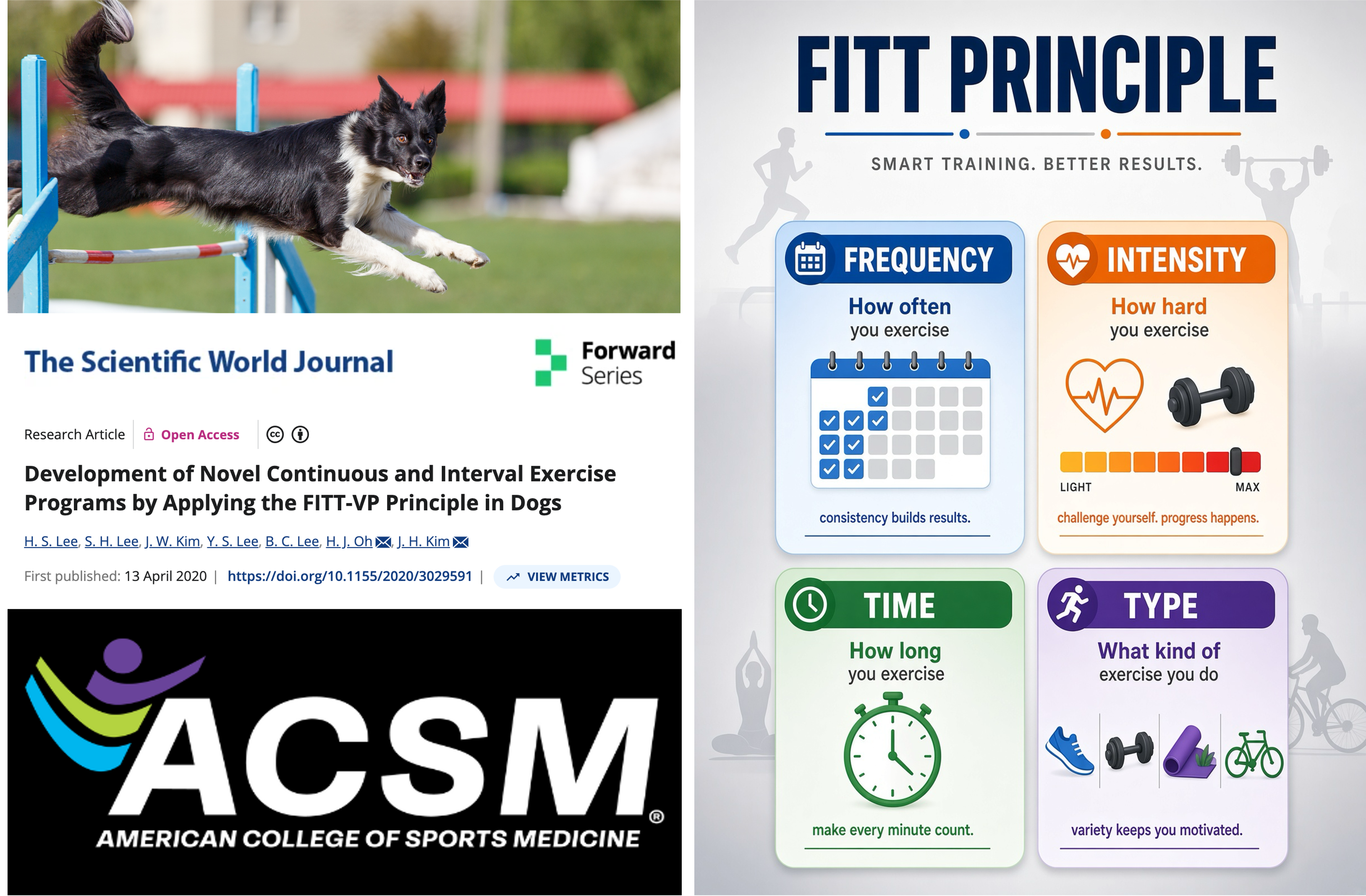
The FITT principle is a foundational framework for designing safe, effective, and individualized exercise programs. It stands for:
• Frequency — How often exercise is performed (e.g., sessions per week or per day).
• Intensity — How hard the exercise is (e.g., effort level, perceived exertion, resistance, or speed).
• Time — Duration of each session or bout (or total work volume via reps/sets/holds).
• Type — Mode or kind of exercise (e.g., static isometric holds vs. dynamic movement, specific modalities like unstable surfaces or gait work).
An expanded version, FITT-VP, adds:
• Volume — Total amount of work (e.g., sets × reps × duration or distance).
• Progression — How the program advances over time (gradual increases to avoid overload or plateaus).
This framework originates from human exercise physiology (e.g., ACSM guidelines) and has been directly applied in veterinary contexts. It helps implement principles like SAID (Specific Adaptations to Imposed Demands) by ensuring training matches the desired outcomes (e.g., functional quadrupedal stability rather than non-specific upright balancing).
General Application of FITT
FITT provides a structured way to manipulate variables for progressive overload while minimizing injury risk. It is used across populations—from healthy individuals to those in rehabilitation—and can be adjusted for goals like strength, endurance, stability, or functional movement. Updated models like FITT-CORRECT incorporate additional factors (e.g., Compliance, Enjoyment, Reversibility) for more dynamic, evidence-based prescription.
FITT Diagram Examples:
Application to Canine Abdominal/Core Strengthening
In canine rehabilitation and conditioning, FITT (or FITT-VP) guides therapeutic exercise programs targeting the abdominal muscles (rectus abdominis, external/internal obliques, transversus abdominis) and broader core for stability, proprioception, gait efficiency, and injury prevention. Research has applied FITT-VP principles to design structured programs in dogs, such as continuous and interval treadmill exercise, monitoring heart rate and physiological responses.
Core work in dogs emphasizes quadruped-functional positions (standing, weight shifts, gait variations on varied surfaces) over non-functional upright postures, aligning with biomechanical evidence on posture-dependent abdominal recruitment and dynamic stabilization during locomotion.
Here’s how FITT applies specifically to canine abdominal/core training (integrating static holds for endurance/stability and dynamic movements for functional strength/coordination):
Frequency (F)
• Beginner/rehab phase: 3–5 short sessions per week (or daily gentle proprioceptive work), with rest or active recovery days to allow adaptation.
• Maintenance/athletic dogs: 4–7 sessions per week, integrated into daily routines (e.g., during walks or as part of weekly training sessions).
• Rationale: Allows recovery while providing consistent stimulus. Higher frequency suits low-intensity core work; monitor for fatigue.
Intensity (I)
• Start low-moderate: Focus on quality and control (e.g., neutral spine, minimal compensation).
• Progress by increasing challenge: Add instability (wobbly boards, balance discs), resistance (gentle theraband or body weight shifts), speed, or duration of holds/movements. Use observable cues like form breakdown or perceived effort.
• Static examples: Hold 3-leg stands or planks until mild fatigue (e.g., 10–60 seconds).
• Dynamic examples: Controlled weight shifts or gait on inclines at a pace that challenges stability without loss of form.
• Tie to prior evidence: Intensity can be modulated to target greater active shortening or shear stabilization as seen in posture and trotting studies.
Time (T)
• Session length: 5–15 minutes for focused core work (shorter bouts to maintain quality and avoid fatigue).
• Per exercise: Static holds of 5–30+ seconds (multiple reps/sets); dynamic reps of 8–15 per side or continuous movement for 30–120 seconds.
• Total volume builds via sets/reps or cumulative time. Short, frequent bouts suit core endurance; longer dynamic sessions build functional capacity.
• In FITT-VP applications to dogs, time parameters helped structure interval vs. continuous work while monitoring responses.
Type (T)
• Prioritize quadruped-functional exercises:
◦ Static: Balanced stands, 3-leg stands, planks/table holds on stable or unstable surfaces.
◦ Dynamic: Weight shifts in stance, rhythmic perturbations, slow gait over cavaletti or on inclines/declines, backing up, or side-stepping.
• Mix static (for baseline stability and endurance) and dynamic (for coordination and locomotion-specific stabilization).
• Avoid or minimize non-functional types (e.g., sustained upright balancing) to respect quadrupedal anatomy and SAID—train movements dogs actually perform.
• Modalities: Unstable surfaces, resistance, or environmental challenges (e.g., varied terrain) enhance proprioception and core engagement.
Volume (V) and Progression (P) — FITT-VP Additions
• Volume: Total work (e.g., 3 sets of 3 × 20-second holds or 10 minutes of dynamic work). Track and gradually increase.
• Progression: Systematic advancement—e.g., from stable to unstable surfaces, static to dynamic, shorter to longer holds, or adding speed/resistance. Progress only when form is maintained and the dog recovers well. This prevents plateaus and supports long-term adaptations.
Practical Example Program Snippet for Canine Core
• Frequency: 4 sessions/week.
• Intensity: Moderate (controlled effort, focus on form; progress instability).
• Time: 8–12 min sessions.
• Type: Mix of static 3-leg stands (quadruped) + dynamic weight shifts and slow trotting variations on varied surfaces.
• Volume/Progression: Start with 3 × 10-sec holds; advance to unstable surfaces or add gentle perturbations over weeks.
This integrates static/dynamic recommendations and functional quadruped emphasis while following SAID (specific to canine movement demands).
Benefits and Considerations
• Benefits: Structured progression reduces injury risk, optimizes adaptations, and improves adherence through measurable variables. It supports evidence-based rehab for conditions affecting core stability or gait.
• Considerations: Individualize based on age, fitness level, injury status, and response (monitor for fatigue or compensation). Combine with overall conditioning (endurance, flexibility). Consult a certified canine rehabilitation professional for tailored programs.
• Evidence Base: Directly applied in canine studies (e.g., treadmill programs via FITT-VP) and broadly in veterinary physiotherapy for therapeutic exercises targeting core, proprioception, and function.
The FITT (and FITT-VP) principle provides a practical, adaptable tool that complements SAID by guiding how to impose specific demands progressively. It is especially useful for transitioning from foundational static stability to dynamic functional core work in dogs.
Key References:
1. Lee HS, et al. (2020). Development of Novel Continuous and Interval Exercise Programs by Applying the FITT-VP Principle in Dogs. BioMed Research International.
2. American College of Sports Medicine (ACSM). (2021). ACSM’s Guidelines for Exercise Testing and Prescription (11th ed.). Wolters Kluwer.