Laurie's Blogs.
Aug 2026
Recent Advances in Canine Syringomyelia and Chiari-like Malformation: Insights from 2025–2026 Literature
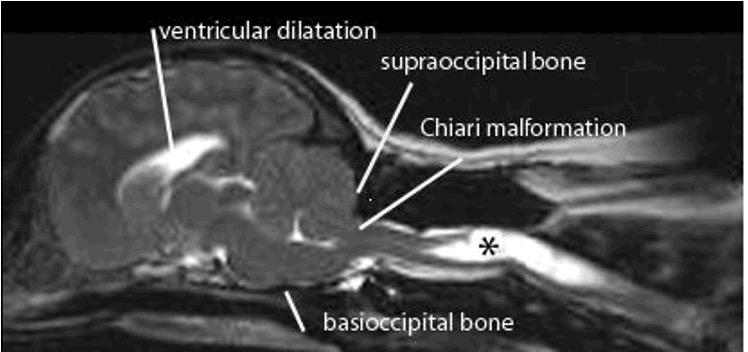
Recent publications (primarily 2025–2026) continue to refine understanding, diagnosis, clinical assessment, and management of Chiari-like malformation (CM) and syringomyelia (SM) in dogs, with a strong focus on predisposed breeds such as Cavalier King Charles Spaniels (CKCS), Pomeranians, and other small/toy breeds.
Surgical outcomes remain a key area of investigation. A retrospective study of 87 small-breed dogs undergoing modified foramen magnum decompression with titanium mesh cranioplasty (preserving a deliberate gap and omitting polymethylmethacrylate) reported sustained clinical improvement in 87% of cases, with no revision surgeries needed over a median 35-month follow-up. Only 13% required ongoing medication for recurrent signs, supporting the technique’s safety and efficacy in preserving decompression space. (Park et al, 2026)
Clinical assessment tools have advanced. The Chiari-like malformation and syringomyelia evaluation (CHASE) questionnaire was developed and validated to quantify owner-reported neuropathic pain and itch signs. It demonstrated strong internal consistency, differentiated affected from healthy dogs, and detected treatment responses (e.g., to pregabalin) where other measures such as quality-of-life scores or quantitative sensory testing did not. Related work linked clinical CM/SM signs in CKCS to higher owner-observed sleep disturbance scores (SNoRE), highlighting the value of discussing sleep-disordered breathing and restlessness with owners. (Valentino, Moore, et al 2026; Valentino & Olby 2026)
Imaging and morphometric studies provide mechanistic insights. Three-dimensional cranial geometric morphometrics in toy breeds and MRI-derived modelling in CKCS have identified associations between cranial conformation, cervicothoracic subarachnoid space narrowing, and SM development. Longitudinal MRI in Pomeranians showed dynamic syrinx changes, with progression in a substantial proportion of cases; furosemide appeared to mitigate increases in maximum syrinx diameter. Prevalence data in asymptomatic Australian CKCS confirmed age-related increases and associations with coat colour. Case reports and series continue to document atypical cerebrospinal fluid flow patterns and spontaneous vocalization as potential indicators linked to cervical disease or SM. Jones et al 2026; McLeay & Child 2026: Nakata et al 2026)
Comparative work notes earlier clinical onset in Syringomyelia (SM) associated with Chiari Malformation (mean ~50.5 months) versus SM associated with other etiologies (mean ~97.6 months), along with more severe neurological deficits in the latter group. Symptomatic therapy—typically corticosteroids plus gabapentin for CM-related cases and NSAIDs ± gabapentin for other etiologies—yielded improvement in roughly half of the CM-associated dogs, while survival was poorer when the etiology was unrelated to CM. (Baka et al 2025)
Collectively, these studies emphasize refined surgical techniques with durable results, validated owner-reported outcome measures, dynamic disease progression, and the ongoing utility of advanced imaging/morphometrics. They reinforce the multifactorial nature of CM/SM and support multimodal clinical decision-making in affected dogs.
References
- Baka, R. D., Savvas, I., Sarpekidou, E., et al. (2025). Epidemiological data, clinical signs, therapy and outcome evaluation in dogs with syringomyelia of different etiology. Veterinary Sciences, 12(4), 376.
- Jones, R., Cirovic, S., Rusbridge, C., et al. (2026). MRI-derived three-dimensional modelling reveals cervicothoracic subarachnoid space narrowing in syringomyelia-affected Cavalier King Charles Spaniels. BMC Veterinary Research, 22(1), 306.
- McLeay, L., & Child, G. (2026). Syringomyelia in Australian Cavalier King Charles Spaniels: Prevalence and changes over 16 years of magnetic resonance imaging screening. Australian Veterinary Journal, 104(1-2), 50–56.
- Nakata, K., Ono, T., Kobatake, Y., et al. (2026). Three-dimensional cranial geometric morphometrics of syringomyelia in toy breed dogs. Veterinary Journal, 318, 106756.
- Park, S. S., Park, J. Y., Han, H. J., et al. (2026). Outcomes of 87 small-breed dogs surgically treated for Chiari-like malformation and syringomyelia. Veterinary Surgery, 55(5), 929–941.
- Valentino, A. J., & Olby, N. J. (2026). Owner observed sleep disturbances in Cavalier King Charles Spaniels with and without clinical signs compatible with a Chiari-like malformation. Animals, 16(14), 2184.
- Valentino, A., Moore, S. A., Fitzgerald, S., et al. (2026). Development and validation of the Chiari-like malformation and syringomyelia evaluation: The CHASE questionnaire. Journal of Veterinary Internal Medicine, 40(1), aalaf040.