Laurie's Blogs.

Aug 2026
Factors affecting veterinary perception of the prevalence of back pain and dysfunction
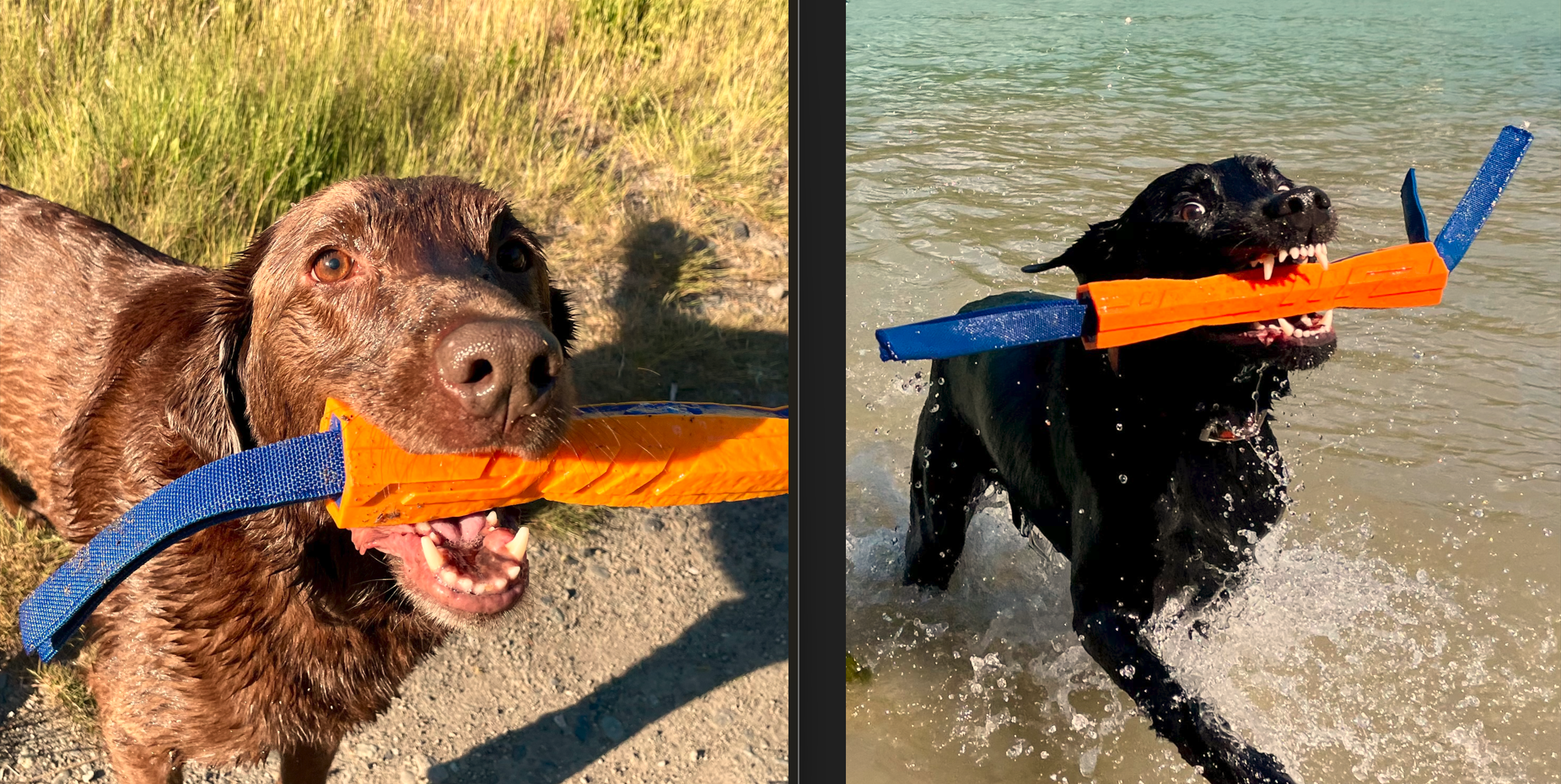
David's dogs - Fig-Jam & Corb - Based on these 2 pictures, can you tell which dog has the more intense personality?
In human medicine, the term “non-specific back pain” has been used for 70 years to describe conditions that result in back pain, yet the underlying cause cannot be detected on imaging or other diagnostic tests. Lower back pain is the second most common complaint reported to general practitioners, and 90% of back pain is considered “non-specific”.
In contrast, the term non-specific back pain is not used in veterinary medicine. Why? Does it not exist in veterinary patients? If it does exist, how prevalent is it? As a first step toward answering these questions, we surveyed veterinarians on their perceptions of the prevalence of back pain.
The published results of that survey can be found here (link). This week’s blog looks at the different factors affecting veterinary perception on the prevalence of back pain and dysfunction (BPAD), and how back examinations are performed. Next week’s blog will look at the perceived prevalence of back pain for a variety of clinical presentations.
Education Background
Because there is more research on the existence of back pain in horses than there is in dogs, we hypothesized that equine veterinarians would appreciate a greater prevalence of back pain compared to canine veterinarians. This hypothesis proved false. No pattern emerged to suggest that equine respondents appreciated a greater prevalence of back pain compared to canine respondents.
We also thought that as part of their veterinary education, equine veterinarians would have received more education on how to perform a back examination compared to canine veterinarians. This hypothesis also proved false. Overall, only 48% of canine respondents reported receiving adequate education on how to perform a back examination, which is a problematically low number, but is still much better than the 26% of equine respondents that reported receiving an adequate education on back examination techniques.
When comparing veterinarians that worked in academia to those who do not, there seemed to be little difference in opinion between the 2 groups. However, when we divided veterinarians into groups based on education background, there were significant differences in opinion.
We hypothesized that veterinarians with board certification in sports medicine and rehabilitation (VSMR), or certification in either spinal manipulation, acupuncture, or rehabilitation therapy, would perceive there to be a greater prevalence of BPAD when compared to veterinarians without these designations. Veterinarians without these designations included general practitioners, surgical specialists, or specialists in another field (neurology, behaviour, internal medicine etc.).
This hypothesis proved mostly true – VSMR specialists or those with certification in spinal manipulation or acupuncture appreciated a greater prevalence than other groups, but those with rehabilitation certification did not. The reason for this is unknown. The discussion below indicates that those with rehabilitation certification frequently palpate for the presence of myofascial trigger points (MTPs), but are less likely to examine osseus structures – individual motion segments, the ribs, or the sacroiliac joints compared to VSMRs or those with certification in spinal manipulation or acupuncture.
Although we hypothesized that there would be significant disagreement between education groups, we did not predict how much disagreement there would be within each education group. For each of the clinical scenarios, opinions between veterinarians within the same education category ranged widely.
Examination Techniques
Respondents were asked about how they performed a physical examination of the back, and those results were compared to the perception of the prevalence of BPAD. We hypothesized that those who examine individual vertebral motion segments, or those that palpate for the presence of myofascial trigger points (MTPs) would appreciate a greater prevalence of BPAD compared to those who do not. This hypothesis proved true.
However, only 52% of canine respondents reported examining each vertebral motion segment. 97% of veterinarians with spinal manipulation certification report doing so, compared to 35% of those with rehabilitation certification and 37% of general practitioners. Of those that examine individual motion segments, most were looking for pain, followed by palpation for an altered resting position, PROM, AROM, and end feel.
Only 40% of veterinarians reported routinely palpating the ribs, mostly palpating for pain. Those certified in spinal manipulation therapy were most likely to do so, and surgical specialists were the least likely (85% vs 23%). In humans, rib dysfunction is a recognized cause of neck and shoulder pain, but research on its significance in canines is almost non-existent.
Sacroiliac joint palpation was more frequently examined, predominantly looking for pain, followed by altered resting position, PROM, AROM, and end feel. 79% of respondents reported examining the sacroiliac joint, including 100% of veterinarians with spinal manipulation certification, compared to 74% of those with rehabilitation certification and 73% of general practitioners. Unlike humans and horses, sacroiliac joint pain has not been proven to exist in dogs. However, the fact that so many veterinarians routinely palpate for it suggests that such pain exists, despite the lack of research.
99% of respondents report routine palpating paraspinal musculature when performing a back examination, predominantly to assess mass, pain, and abnormal tone. Only 46% of respondents reported palpating for myofascial trigger points. Over 82% of those with VSMR specialization, or certification in spinal manipulation, acupuncture, or rehabilitation certification reported routinely palpating for myofascial trigger points. Conversely, less that 23% of general practitioners, or specialists in fields outside of VSMR reported palpating for myofascial trigger points.
Bottom line
To quote directly from the research paper:
Perceptions on the prevalence of BPAD vary widely, but respondents with sports medicine specialty status, or certification in either spinal manipulation or acupuncture therapy, are more likely to perceive the existence of BPAD compared to specialists in other disciplines, general practitioners, or those certified in canine rehabilitation therapy. Respondents who examine individual vertebral motion segments, or that palpate for myofascial trigger points are more likely to detect BPAD compared to those who do not.
We conclude that an axial skeletal examination should include palpation of individual vertebral motion segments, the ribs, and the sacroiliac joints - assessing for pain, range of motion, end feel, and neutral resting position. The myofascial component of the axial examination should include palpation for myofascial trigger points, as well as assessment of mass, tone, and myalgia.
This research highlights the need for a standardized format when performing an axial physical examination, both in clinical practice and in research. Moving forward, researchers performing axial examinations as part of their methodology, should describe exactly how those examinations are performed.
Resource:
Lane D and Haussler KK (2026) Factors affecting veterinary perception of the prevalence of back pain and dysfunction in dogs and horses. Front. Vet. Sci. 13:1857696. doi: 10.3389/fvets.2026.1857696