Laurie's Blogs.
Sep 2026
Incline and Decline Treadmill Trotting Alter Specific Forelimb Muscle Activity in Dogs
A 2026 study in the American Journal of Veterinary Research examined how graded treadmill slopes change thoracic-limb muscle activity in trotting dogs. The findings are directly relevant to canine rehabilitation, where incline and decline trotting are commonly used to progress loading after orthopedic injury.
Trotting is prescribed often because it is symmetrical and repeatable. Changing treadmill slope is thought to alter joint mechanics and limb load so that specific tissues can be targeted as programs advance. Until recently, most electromyography (EMG) data on incline and decline work in dogs focused on the pelvic limb. Forelimb data were limited to agility tasks, comparisons with stance, or level walking and trotting. That left a gap for conditions frequently seen in companion, sporting, and working dogs, including biceps tendinopathy, supraspinatus tendinopathy, and other injuries to the shoulder-stabilizing muscles.
The thoracic limb has a primary role in body-weight support and postural stability during the trot. Shoulder and elbow muscles contribute to shock absorption, braking, and propulsion, and individual muscles show task-specific activation patterns. Understanding how slope changes that activity is useful when planning later-stage rehabilitation for shoulder and elbow disease, while trying not to overload compromised structures.
This paper follows earlier work by Cain and colleagues showing that incline and decline walking change peak and average activity in selected forelimb muscles. The present study asked the same question at the trot, the gait often introduced once a dog is able to walk well on the treadmill.
Study design
Twelve sound adult large-breed dogs (21.4 to 35.2 kg) were enrolled after orthopedic and neurologic examination and force-platform screening. Dogs were excluded for pain, restricted joint motion, gait abnormality, muscle asymmetry, proprioceptive deficits, or more than 5% left-to-right peak vertical force asymmetry. All dogs were habituated to the treadmill before data collection.
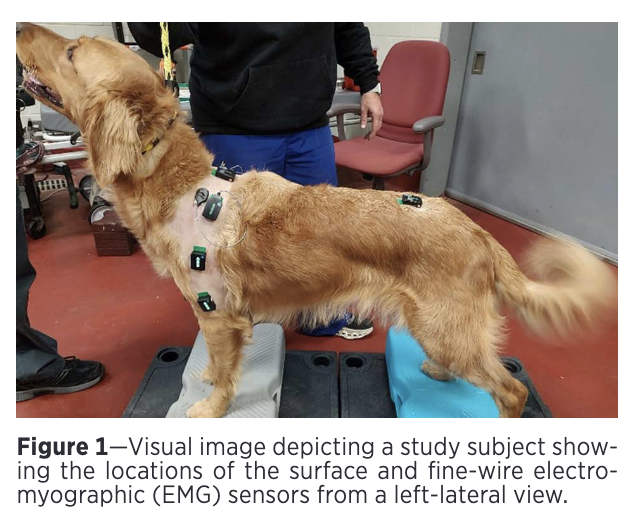
Surface EMG was recorded from the scapular portion of the deltoideus, the lateral head of the triceps brachii, and the biceps brachii. Fine-wire EMG was recorded from the supraspinatus. Dogs trotted at an individually selected comfortable speed (5.2 to 8.0 km/h) on a level treadmill, 5% incline, 10% incline, 5% decline, and 10% decline. Condition order was randomized. Peak EMG reflected the highest activity in a gait cycle. Average EMG reflected total activation across the cycle. Values were normalized to each muscle’s maximum signal across conditions.
Usable recordings were obtained from 9 of the 12 dogs. Left and right sides did not differ and were pooled.
Findings
The authors hypothesized that decline trotting would increase activity in the selected muscles and that incline trotting would decrease it. The results only partly matched that prediction.
Incline trotting increased activity in muscles associated with propulsion and shoulder and elbow stabilization:
- Peak supraspinatus activity increased from level to 5% incline and again from 5% to 10% incline.
- Peak and average triceps activity increased with steeper incline, with the larger changes appearing at 10%.
Decline trotting increased activity in muscles associated with braking and control:
- Average deltoid activity increased from level to 5% decline, from level to 10% decline, and from 5% to 10% decline. The largest increase was at 10% decline.
- Peak triceps activity increased from 5% to 10% decline. Average triceps activity also increased between those two decline grades.
Biceps brachii activity did not change significantly at any slope tested.
Average supraspinatus activity and peak deltoid activity also did not differ significantly across conditions. Some statistically significant changes were smaller than 10% and were described by the authors as being of questionable clinical importance. Larger shifts, particularly average triceps activity on a 10% incline and average deltoid activity on decline, are the changes most likely to matter when an exercise is repeated across sessions.
Clinical relevance
The authors conclude that small changes in treadmill slope during trotting can selectively alter demand on specific thoracic-limb muscles.
Incline trotting preferentially increased peak supraspinatus activity and both peak and average triceps activity. They suggest this supports the use of uphill trotting when the goal is greater concentric force production to propel the dog up the slope, along with greater dynamic stabilization at the shoulder and elbow. Potential applications include later-stage rehabilitation for supraspinatus tendinopathy, shoulder arthropathy, and postoperative shoulder recovery, provided tissue healing and joint integrity allow the increased load. Increased triceps activity is also relevant after elbow injury or surgery, when progressive strengthening of the elbow extensors is indicated.
Decline trotting increased average deltoid activity and peak triceps activity. The authors interpret the deltoid change as more sustained activation across the gait cycle rather than a brief peak load, consistent with prolonged eccentric or stabilizing activity during braking and controlled shoulder flexion on the way down. They suggest decline trotting may be useful for strengthening, neuromuscular control, endurance, and shoulder stability when controlled loading is desired without high peak forces. They also advise caution in dogs with dynamic shoulder instability or elbow arthropathy, because eccentric demand may aggravate symptoms if it is introduced too early or increased too quickly.
The absence of significant change in biceps activity suggests that incline and decline treadmill trotting may be less useful for selectively targeting this muscle. It also suggests that biceps pathology may not be a contraindication for slope work at the trot, because demand on the muscle did not increase disproportionately.
The authors emphasize gradual progression. Incremental 5% changes in slope provide a practical way to increase or decrease load on specific forelimb muscles as a dog moves from rehabilitation into conditioning.
Limitations
The sample was small, and the number of usable recordings varied by muscle, particularly for biceps. Sensor placement was based on palpation. Two dogs required brief sedation for fine-wire electrode placement. The subjects were sound dogs, so the results describe loading patterns in normal trotting rather than in clinical patients.
Even with those limits, the study provides a clearer basis for choosing treadmill slope at the trot: incline to increase supraspinatus and triceps demand, decline to increase sustained deltoid activity and some triceps demand, and neither slope as a specific biceps-loading strategy.
Reference
Stanford K, Cain RM, Millis D, Drum M, Richards J, Levine D, Ursini T. Incline and decline treadmill trotting produce electromyographic changes in specific canine shoulder muscle activity: implications for therapeutic exercise. Am J Vet Res. Published online June 23, 2026. doi:10.2460/ajvr.26.04.0180
https://avmajournals.avma.org/view/journals/ajvr/aop/ajvr.26.04.0180/ajvr.26.04.0180.xml